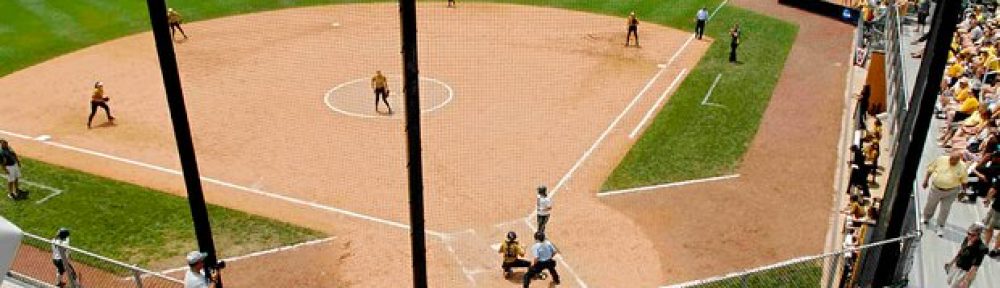
Seattle Regional

Washington – Washington is another one of the national powers that resides in the Pac 10.  To show you how difficult the conference is, the Huskies earned the 12th seed nationally and that’s after going 9-12 in conference.  They did load up in the preseason, however, as they played in the San Diego Classic, the Cathedral City Classic and Judi German Classic.  Including conference play, Washington played 14 NCAA Tournament teams, going 13-12 against them.

Niki Williams is the statistical giant for this year’s Huskies, knocking 13 balls out of the yard and driving in 50 runs.  Both are team highs.  She also has 11 doubles, which is good for second on the squad.  Jenn Salling is hitting .373, with a team-high 15 two-baggers, 53 hits and 43 RBI, both of which are second best on the squad.  Kimi Pohlman is the only Huskie hitting over .400, as she has a team-high .443 average.  She also has 74 hits, scored 52 times and stolen 22 bags, all of which are tops on the team.

Kaitlin Inglesby is the team’s top pitcher, having racked up a 21-7 record.  She has a 2.25 ERA this season, having pitched 183.2 innings.  In her 38 appearances, she has struck out 137 batters

BYU – The Cougars won their third consecutive Mountain West title when they swept a doubleheader from Utah this weekend.  The team played 14 games against ranked opponents in the preseason and went 5-9 against them, defeating tough teams like UCLA, Texas A&M and California.  The Cougars come into the postseason having won 14 of their last 15.

BYU has six players hitting over .300, but none is having as impressive of a season as Jessica Fitu, who is second on the team with a .382 average.  She has 63 hits, 11 doubles, 12 home runs, 64 RBI and a .691 slugging percentage, all team bests.  Caschjen Atagi has knocked around 10 doubles, 10 home runs and 44 RBI.  Delaney Willard has 11 bombs, nine doubles and 40 RBI

Paige Affleck is the team’s ace.  She compiled a 24-11 record during the season and has a nifty 1.97 ERA.  She’s retired 207 opponents via strikeout.

Portland State – Portland State captured its third Pacific Coast Conference title after having done so in 2006 and 2009. They matched Loyola Marymount, the team they defeated in the finals to win the title this year, for the most conference titles in the nine-year history of the league.  The trip to the NCAA Tournament marks the second in three years for the Vikings.  Portland State faced seven teams that qualified for the NCAA Tournament, and while only winning one of those matchups, they played teams like Stanford, UCLA and Oregon tight.

Jenna Krogh leads a balanced Viking offense with a .405 average, 38 runs and 64 hits.  She also has legged out an impressive six triples.  Lacey Holm swings a big stick for Portland State, as she is second on the team with five round-trippers and leads the squad with 40 RBI.  Carly McEachran leads the team with six home runs and has added 30 RBI, one of two players to have that total.  The Vikings also have three players who have hit four home runs each.

Nichole Latham and Anna Bertrand have identical 16-8 records.  The closeness in statistics is eerie.  Latham has started 24 games and appeared in 28, while Bartrand has started 23 and appeared in 30.  Latham has pitched exactly two more innings (155.2-153.2).  Bertrand has more strikeouts tho with 161, while Latham has 98.

Auburn – While the Tigers’ 39-17 record might not impress people, the wins they have accumulated towards the end of the season show how much they have evolved into a team heading into the postseason.  But in the last three weeks, they have defeated top-10 Georgia twice and upset number three Florida in the SEC tournament’s first round.  They also gave Tennessee a tough time in the semifinals.

Auburn is an even balanced team offensively, as four of their players have at least 44 hits and seven total have 30 or more.  Morgan Estell is hitting .378 and leading the team with 59 hits, including a team-high 17 doubles and tied for the team-high in home runs with six.  Kyndall White and Amber Harrison are also tied for the team lead in home runs with six each.  Harrison also has 16 doubles, making 22 of her 36 hits either doubles or home runs.

If anyone is looking for the true definition of a three-woman pitching rotation, look no further than the Auburn Tigers.  Their three starters have started 19, 19 and 18 games, respectively.  Angel Bunner, who has started 19 games, leads the squad in wins with 16 and also has a team-low 1.58 ERA.  While Lauren Schmalz has 14 wins, she also has the highest ERA, at 3.11.  Jenee Loree is the third on the team with nine wins.  The eerie part is that all three have extremely similar strikeout numbers.  Schmalz has 143, Bunner 113 and Loree 107.

>New Mexico Bowl Preview

>BYU vs. UTEP

The New Mexico Bowl features a team from the Mountain West (BYU) and Conference USA (UTEP).  UTEP comes into this bowl as possibly one of the few teams that had a losing record in conference play, after finishing 3-5, en route to a 6-6 record.  After starting the season 5-1, the Miners lost five of their next six games, including three games in which they lost by 10 points of fewer, two of those being by four and three points, respectively.

The Miners don’t do anything amazing and are middle of the road in all of the major statistics.  They are 60th in passing yards (220 yd/pg), 69th in rushing yards (150 yds/gm), 70th in scoring offense (26 pts/gm) and 58th in points allowed (25 pts/gm).  The offense is led by quarterback Trevor Vittatoe, who has thrown for over 2,500 yards and 19 touchdowns.  His favorite target is Kris Adams, who has 44 catches for 917 yards and 11 touchdowns.

BYU is the complete opposite of their opponents.  They started 1-4, before winning five of their next seven to finish 6-6 and third in the Mountain West.  The Cougars are led by their defense and running game.  The defense is ranked 33rd in the country in total defense, after giving up only 339 yards per game.

The offense isn’t too shabby either and has been quite stellar on third downs, converting on 45 percent of their opportunities, good enough for 27th in the country.  And all of this is done behind freshman quarterback Jake Heaps.  Heaps has thrown for 2,052 yards and 11 touchdowns in his rookie campaign.  His favorite target is JJ Di Luigi, who is also the team’s leading rusher.  He has rushed for 819 yards and seven touchdowns, while hauling in 42 passes for 422 yards.

>Rivalry Week Part 2

>Michigan-Ohio State

   The annual match up between the two Midwest state schools has been held at the end of the regular season since 1935 (with exceptions in 1942, 1986, and 1998). Since 1918, the game’s site has alternated between Columbus, Ohio, and Ann Arbor, Michigan, and has been played in Ohio Stadium since 1922 and Michigan Stadium since 1927. Through 2009, Ohio State and Michigan have decided the Big Ten Conference championship between themselves on 22 different occasions, and have affected the determination of the conference title an additional 26 times. 

   The inaugural meeting between Ohio State and Michigan at Ann Arbor in 1897 resulted in a lopsided victory for Michigan, with the Wolverines posting a 34–0 win over Ohio State’s Buckeyes. The first game foretold a long Michigan winning streak, with Michigan winning or tying every match from 1897 to 1912 and thereby compiling a 12–0–2 record before the contest was postponed for several years. The Ohio State Alma Mater “Carmen Ohio” was written on the train ride home to Columbus following the 1902 contest, which saw Ohio State losing to Michigan, 86–0. The lyrics and melody (Spanish Chant) have remained largely unchanged since its conception.

   The 1950 contest, known as the Snow Bowl, is perhaps the most famous game in the rivalry. Eighth-ranked Ohio State was scheduled to host the game on November 25 in Columbus amidst one of the worst blizzards on Ohio record. The Buckeyes, who led the Big Ten, were granted the option to cancel the game against Michigan, which would have, by default, given the Buckeyes the Big Ten title outright and won them a trip to Pasadena for the Rose Bowl. Ohio State refused, and the game was set to be played. Amid howling snow and wind, in what was probably the most literal example of a “field position” game, the teams exchanged 45 punts, often on first down, in hopes that the other team would fumble the ball near or into their own end zone. Ohio State’s Vic Janowicz, who would claim the Heisman Trophy that year, punted 21 times for 685 yards and also kicked a field goal in the first quarter for the Buckeyes’ only points. Michigan capitalized on two blocked punts, booting one out of the back of the end zone for a safety and recovering another one in the end zone for a touchdown just before halftime. Despite failing to gain a single first down or complete a single forward pass, Michigan gained a 9–3 victory, securing the Big Ten title and a Rose Bowl berth.

   While Michigan leads the series 57–43–6, OSU has won the last six meetings.

Florida-Florida State

  
The University of Florida has fielded an official varsity football team every season since 1906, with the exception of 1943. Although Florida State College (one of the predecessor institutions of Florida State University) sponsored a varsity football team from 1902 to 1904, the Florida Legislature converted Florida State College into the Florida Female College, the state’s new all-women’s college in 1905. The college’s name was changed to “Florida State College for Women” in 1909, and it remained so until the college became co-educational in 1947, when the modern Florida State football team was established.

   Almost immediately, Florida State’s football coach, players and students began calling for the Gators to play the new Florida State football team. The University of Florida, however, was reluctant to treat Florida State as an equal. A proposed bill mandating that Florida play Florida State in football and other sports was proposed in 1955 but was voted down in the Florida Legislature. However, Florida Governor LeRoy Collins asked president J. Wayne Reitz of the University of Florida to schedule a yearly football series between the two state universities, and the two schools’ athletic directors eventually negotiated a contract that started the football series in 1958.
   
   In an otherwise unremarkable game coming in to this 8th annual contest between the burgeoning rivals, this game established the rivalry in full due to the controversy that surrounded its outcome. In a tight contest, UF led the Seminoles late in the game, 22-19. FSU had the ball at the Gator 45 yard line with 17 second left in the game. On first down, wide receiver Lane Fenner entered the game in place of FSU’s star receiver Ron Sellers. FSU quarterback Gary Pajcic took the snap, Fenner got behind UF defenders, and Pajcic lofted a pass to Fenner in the front corner of the end zone for what appeared to be a game-winning FSU touchdown. However, referee Doug Moseley signaled that Fenner did not have control of the ball before rolling out of bounds and ruled the pass incomplete

   UF ended up holding on for a 22-19 win, but the controversy heated up after the game when photos that apparently showed Fenner making the catch in the endzone were published in state newspapers. Debate over whether or not the play should have been ruled a touchdown continues to this day.

   The Gators lead the overall series 33–19–2, though have only had an 18–17–1 record against the Seminoles since Bobby Bowden became FSU’s head coach in 1976.

Utah-BYU

   The University of Utah (Utah) and Brigham Young University (BYU) have a longstanding athletic rivalry that encompasses several sports. The annual college football game is frequently referred to as the Holy War.  In the 1890s, when BYU was still known as Brigham Young Academy, the two schools started competing athletically.  Both schools were founded by the LDS church, have significant percentages of LDS students and faculty as well as many historical and customary affiliations with Mormonism such as LDS institutes and dry campuses. As much as religion is a common historical foundation for the rivalry, it has also been a source of animosity and many have sought to downplay the aspect of religion. BYU (aka “the Y”) is owned by The Church of Jesus Christ of Latter-day Saints (“LDS or Mormon Church”). The University of Utah (aka “the U”) is a public state-owned school. Because this rivalry includes a “church vs. state” dimension, many fans of both schools use it as a forum to vent deeply held feelings and perceptions.

   Utah claims that the football rivalry began in the late 19th century, when Utah played the Brigham Young Academy six times between 1896–1899. BYU does not count these games in their official records, since it was not then known as BYU, but BYA. Furthermore, BYU claims that the first of those football games, a 12–4 Utah victory in April 1896, was in actuality a practice-scrimmage to prepare for the following fall season. But whether or not the game meant anything to the schools at the time, it certainly meant a great deal to the fans. At the end of the match, a fight broke out between fans of the two schools.

Georgia-Georgia Tech

   The two schools are separated by 70 miles (110 km) and have been heated rivals since 1893. 

   The first known hostilities between the two schools trace back to 1891. The University of Georgia’s literary magazine declared the school’s colors to be “old gold, black, and crimson.” Dr. Charles H. Herty, the first UGA football coach, felt that old gold was too similar to yellow and that yellow “symbolized cowardice. Also in 1891, a student vote chose old gold and white as Georgia Tech’s school colors. After the 1893 football game against Tech, Herty removed old gold as an official school color. Tech would first use old gold for their uniforms, as a proverbial slap in the face to UGA, in their first unofficial football game against Auburn in 1891. Georgia Tech’s school colors would henceforth be old gold and white.

   The game has been played 104 times according to Georgia Tech and only 102 times according to Georgia record books. Georgia discredits two games in 1943 and 1944 (both years in which Georgia Tech won) because many of their players went to fight in World War II, though official college football records include the games.

   The record between the two teams is 60 Georgia wins, 39 Georgia Tech wins, and 5 ties.  

>College Football Preview: B cont’d

>Buffalo – Buffalo will have a new look on the sidelines this year, as Jeff Quinn takes over for Turner Gill, who is the new coach at Kansas. Quinn comes to Buffalo from Cincinnati where he was an assistant under Brian Kelly who is the new coach at Notre Dame. Quinn oversaw a no-huddle spread offense that was responsible for 7.28 yards per play — second in the nation to Nevada. The Bulls will be looking to go to their second bowl in three years after finishing 5-7 last season.

Offense – The offense will be under new direction, because the 2009 starter doesn’t return this year, leaving only Jerry Davis as the only quarterback who has seen collegiate action. Davis, a sophomore, saw action in five games last season, completing eight of 15 passes for 145 yards and a touchdown. Alex Dennison redshirted last year and will look to come in and challenge Davis for the starting role.

Fortunately for the Bulls, they return an experienced trio of running backs from last year. Ike Nduka broke out onto the scene in a big way. Nduka, then a junior, had not had any carries in his entire career before taking over for an injured James Starks and rushing for 598 yards and six touchdowns on 96 carries. Another senior, Brandon Thermilus, is coming off of a successful junior campaign as well, after rushing for 560 yards and four touchdowns.

The hardest replacements will come in the wide receiver corps, where they have to replace both starters, both of whom were All-MAC receivers. Terrell Jackson returns after a sophomore campaign where he caught 25 balls for 250 yards, but no touchdowns. Thermilus is the second leading receiver returning after he caught a mere nine balls for 99 yards. Marcus Rivers, Ed Young and Saron Hood, among other redshirt freshman, will be fighting for playing time as well.

Defense – The defense brings back eight starters from a team that gave up 342 yards per game and 23.8 points per game. They also forced 18 turnovers.

Just looking at the stats, it would be easy to say that the defensive backfield is the position of strength in this year’s defense and, in this case, that would be true. Five of last year’s seven top tacklers were defensive backs, and four return, including three starters. Davont Shannon, a three-time All-MAC First Team member, returns for his senior season after leading the team in tackles in 2009. He not only led the team in tackles with 97, but also had a team-high 8.5 tackles for loss as well as being a co-leader with two interceptions. The Bulls return both their cornerbacks in Dominic Cook and Josh Thomas. Last season, Cook had 55 tackles and a team-high 10 pass breakups, while Thomas had 45 tackles, nine pass breakups and a forced fumble and fumble recovery each.

Another strong part of the defense will be their linebacker corps, where they return their entire corps. Looking to lead the squad will be Justin Winters who finished third on the squad with 79 tackles. Seven of those tackles were for loss. He also had four and a half sacks, which ranked second on the squad. Scott Pettigrew also returns after finishing fourth on the team in tackles. He enters his junior season after being in on 55 stops, one and a half sacks, three fumble recoveries and two forced fumbles last year. Raphael Akobundu started the last two games of his junior season and looks to steal the third starting spot for good this year. He finished with 37 tackles last year.

The defensive line brings back two starters, but brings back tons of experience. Anel Montanez returns at the tackle position after starting all 26 games the past two seasons. The senior had 35 tackles, including four for loss last season. End Steven Means returns after turning in a successful freshman campaign where he led the team with five sacks and six and a half of his 25 tackles were for loss.

Recruiting – Th 2010 recruiting class is made of 22 student-athletes, 12 of whom are slated to play on the offensive side of the ball. Aaron Walters comes up to Buffalo from South Carolina after posting some staggering numbers as a high school senior. The wide receiver caught 71 balls for 1,200 yards and 19 touchdowns in his last year. Kendall Roberson comes up from the Peach State as a linebacker. His senior season saw him put up a stat line of 66 tackles, seven sacks, three fumble recoveries, two forced fumbles and an interception.

Schedule – The Bulls start the season against Rhode Island before facing three consecutive tough non-conference opponents in Baylor, UCF and UCONN. The UCONN games marks a stretch in the middle of the season that sees Buffalo play three road games in a row, with a bye week sandwiched in between. After an October 16th games against NIU, however, the Bulls then have four of their next six at home, including a home date with Temple, who figures to be one of the favorites in the MAC. Three of the final four games will also be broadcast on ESPNU.

BYU – The Cougars are coming off of an 11-2 season that saw the team defeat three ranked team, including a 44-20 shellacking of Oregon State in the Las Vegas Bowl. The team will need to have many younger players stand out if they want to return to last year’s form, as many of the important players from last year’s squad have departed.

Offense – The Cougars are going to have to replace Max Hall, who finished last season with some ridiculous stats. Hall, who is now in the NFL with the Arizona Cardinals, completed 67 percent of his passes for over 3,500 yards and 33 touchdowns. Riley Nelson returns as the only quarterback who has seen any college football action, so the team will look to its younger freshmen to put up a fight for the wide-open starting position.

As if losing your stud quarterback wasn’t enough, BYU also loses it’s starting running back from last year. Last year’s starter, Harvey Unga, rushed for 1,087 of the Cougars’ 1,894 rushing yards and 11 of 26 touchdowns last season. However, the team does bring back the next four top rushers. JJ Di Luigi returns after rushing for 248 yards and three touchdowns, while Manase Tonga leads the returnees with four touchdowns.

No matter who the quarterback is, he will have the luxury of having six of the top eight receivers from last year return. McKay Jacobson leads the team in returning yards with 556 and is tied with three others with four touchdowns last season. Jacobson averaged over 24 yards per catch, while all other receivers except one averaged double digit yards per catch.

Defense – As impressive as the offense was, the defense was equally so. The defense gave up 21.5 points per game and only allowed 329 yards per game, nearly 100 yards less than what their offense averaged.

Like their offense, the defense loses many of the starters from last year. Only four of the top 10 tacklers return. Luckily for the defensive secondary, two of the four return after finishing first and fourth on the team respectfully. Andrew Rich returns for his senior season after leading the team with 85 tackles and tying for the team lead in interceptions with four. Brandon Bradley, the fourth highest tackler, also returns in the secondary. He added 64 tackles, four passes broken up and two forced fumbles. Brian Logan is coming off of an impressive season in which he started 12 games. He finished the season with 44 tackles and three interceptions as well as an astounding 14 passes broken up.

Two returning linebackers played in double digit games last season. Jordan Pendelton played in 13 games and started 10 during the 2009 season. He finished the year with 52 tackles, six tackles for loss and three sacks. He also had three passes broken up. His tackles for loss and sack totals lead all returnees. Brandon Ogletree also returns after playing in 10 games in 2009. He will fight for a starting spot after being in on 19 tackles.

Recruiting – The Cougars bring in 26 players in the 2010 recruiting class that has been ranked in the top 25 of at least one ranking list. Jake Heaps comes in as the No. 1 quarterback in the nation and will look to fight for the starting nod. As a senior, Heaps threw for 3,191 yards and 45 touchdowns on his way to a state title win. But Heaps isn’t the only highly-rated recruit in this year’s class. Eight signees are ranked in the top 25 at their positions. Alani Fua comes in as the No. 25 weakside defensive end after coming up with 71 tackles, nine sacks, two fumble recoveries and three forced fumbles. Zac Stout comes in as the No. 8 middle linebacker and put up incredible stats in his senior season. He totaled 112 tackles, including 81 solo stops.

Schedule – The schedule doesn’t look as daunting as it did last year, as Washington replaces Oklahoma, but that can be deceiving. The Huskies will be getting stud quarterback Jake Locker back after he suffered an injury last year. Luckily for BYU that game is at home. Unfortunately for the team, however, three of their next four games are on the road, including a game at Florida State. The Cougars’ two toughest MWC games against TCU and Utah are both on the road, including a season-ending game in Salt Lake City.

>NCAA Softball Super Regionals Part 2

>In the first part, I previewed the left side of the bracket. Here I will preview the right side, one which features the defending champs, Washington.

Regional # 5 – Washington vs. Oklahoma

Washington – For the second-straight year, the Huskies (48-6) faced the daunting task of going against one of the country’s most underrated pitchers in lefty Danielle Spaulding, who threw two no-hitters in her four appearances over the weekend. After Spaulding no-hit Nebraska on Friday to open the weekend, UW used an unearned run to win the first meeting between the teams, 1-0, on Saturday.They needed extra innings to win 2-1 on Sunday, but the reigning champs will once again be making a trip to the Super Regionals, a place they have been every year except one since the Super Regionals format was created. 

The Huskies’ Danielle Lawrie picked up three wins on the weekend, giving up just one run in 22 innings, while striking out 39.  The stud pitcher gave up a mere six hits and one earned run.

The normally prolific Washington offense was quieted this past weekend by some magnificent pitching by their opponents, UNC’s Spaulding and North Dakota State, a team which made the Super Regionals last year.  Shawna Wright had the game-winning hit for UW. She had gone hitless until that point.  Lawrie and Nikki Williams each had key home runs for the Huskies.

Washington holds a 7-6 series lead, including a 7-4 victory earlier this year.

Oklahoma – The Big 12 Tournament Champs are coming off of a 3-0 weekend, which saw they defeat one of the top pitchers in the country, Fordham’s Jen Mineau twice.

Oklahoma has won 14 straight and has out-scored opponents 77-5 in that stretch.  OU is 1-6 in Super Regionals since the format was introduced in 2005.  The Sooners are appearing in their first Super Regional since 2008.  Oklahoma’s only win in Super Regional play was a 2-0 win at Arizona on May 24, 2008.

OU is hitting .318 as a team during its 14-game winning streak and has scored 77 runs.  The Sooner also boast quite a potent offense, as freshman Jessica Shults holds the Oklahoma freshman record for home runs (14) and runs batted in (61) in a season.  Shults’ 61 RBI are tied for fourth most in a single season at Oklahoma and rank as the ninth best in a single season in the Big 12.  Amber Flores is the first player in Big 12 history to win the Player of the Year award twice.  Flores is OU’s career leader in home runs (53). The mark is four shy of tying the Big 12 career record.  The Sooners are not all about power. Brianna Turang ranks fifth in the Big 12 with 20 stolen bases on the season and Ten Sooners have drawn double-digit walks this season, including five with 20 or more.

Along with some stud freshman hitters, the ace of the pitching staff is frosh Keilani Ricketts. Ricketts has not allowed an earned run in the last 28.0 innings pitched.  During the 14-game win streak, Ricketts has a 0.39 earned run average and six shutouts, including one in the Big 12 Championship game.  Ricketts’ 324 strikeouts this season are the second-most in a single season at OU.  She has a 1.19 ERA and 14 shutouts to her name.

Regional # 6 – California vs. Georgia

California –  After winning sweeping the Columbus Regional to win its 11th Regional title in the past 12 years, the No. 11-seeded California softball team has a new task at hand in No. 6-seeded Georgia at the Athens Super Regional.  After the Regional title, Cal improves to 44-17 overall, 60-31 in Regional games and 81-55 overall in the NCAA postseason.

The Bears bring a seven-game winning streak to Athens after sweeping Oregon State and the Columbus Regional. Cal played 16 of the tournament’s teams this year, posting a 19-16 record against them.

Five of Cal’s starters are batting .300 or above with Jamia Reid pacing the Bears at .389 and 48 steals.  Cal’s 285 RBI is a new program team season high, smashing the old record of 279, which was set in 2008. Valerie Arioto is currently tied with Veronica Nelson for the single-season home-run high with 19, now holds the season record for runs (60) and RBI (60) and is currently fifth on season walks with 77.

As good as Arioto is at the plate, she may be even better on the mound.  She has posted a She leads the team in wins (21), ERA (1.26) and strikeouts with 260.  She is not the only stud pitcher for the Bears, however.  Freshman sensation Jolene Henderson has made quite the transition to college softball, picking up 20 wins and a 1.53 ERA, along with three saves.

The Bears hold a 1-0 series lead against Georgia, with the win coming on Valentines Day in 1999.

Georgia – After going 3-0 in their Regional, the Bulldogs will host their second consecutive Super Regional.  The Bulldogs went 3-0 as a regional host this year to improve to 13-4 in the UGA Softball Stadium
during regional play.

A total of 11 Bulldogs have combined to hit a single-season school record 92 home runs (1.61
per game). The new record surpassed the 2009 squad’s 85 home runs (1.44 per game). Bulldogs to hit home runs in 2010: Alisa Goler (14), Megan Wiggins (14), Brianna Hesson (13), Ashley Razey (13), Taylor Schlopy (11), Laura Trout (8), Jennie Auger (5), Ashley Pauly (5), Kristyn Sandberg (5), Amberlie Saxton (3) and Brittany Hubbard (1).  Nine Bulldogs have provided double-digit RBI this season. All nine in double figures have at least 15 RBI with eight driving in at least 29 or more runs.

Georgia is one of a very small number of teams which has three pitchers in double digit wins.  Sarah McLoud picked up wins in all three games last week and has an 11-1 record on the year, as well as a 2.71 ERA.  Erin Arevalo leads the team in victories with 18, as well as 158 strikeouts.

Regional # 7 – BYU vs. Arizona

BYU – Along with Oregon, BYU is one of two unseeded teams to make the Super Regionals.  For the first time in program history, BYU (46-11) will participate in the NCAA softball tournament’s second round.  The Cougars advanced with a sweep of the competition last weekend in Austin, Texas, defeating East Carolina, 1-0; No. 7-seed Texas, 9-8; and East Carolina again in the championship game, 8-3. 

The Cougars and the Wildcats have a brief history, marked most recently by a meeting on Feb. 26, at the Cathedral Classic in Palm Springs. Arizona was victorious in five innings, improving their all-time record against BYU to 3-0.

BYU senior Angeline Quiocho was named MWC Player of the Year, freshman J.C. Clayton garnered
MWC Freshman of the Year and Cougar head coach Gordon Eakin captured MWC Coach of the Year honors for the second consecutive season.  Quiocho has been a terror for opponents, hitting 28 home runs, driving in 90 Cougars.


Paige Affleck is the workhorse on the mound for BYU.  She leads the team with 32 wins, a Mountain West Conference record, as well as 221 strikeouts, which is second on the BYU season-high list.  

Arizona Arizona won the Tucson Regional in three games over Cornell, and Hofstra twice – with the Regional finale lasting 12 innings before Arizona pulled out a come-from-behind win on a grand slam by Lini Koria.  For the 15th time in its 24-year participation, Arizona remained at home for initial rounds play in the Championships. The Wildcats have been a host for initial rounds 14 times, and later for Super Regionals four times.  Arizona has a 137-40 mark in NCAA play in its 23 seasons of competition from 1987-2009. The Cats are 70-8 in Regional play and 10-3 in Super Regionals (since 2005).
Like many of the other teams in the Super Regional round, Arizona boasts a potent offense, one which has outscored opponents 431-131.  Four Wildcats have hit at least 16 home runs, led by Bridget Del Ponte, who has smacked 21 round trippers.   She also leads the team with 75 RBI.  The other thee with double digit home runs each have over 50 RBI as well.  

Freshman pitcher Kenzie Fowler has been quite the stud this year, compiling a 33-6 record.  She also boasts a 1.25 ERA and 312 strikeouts to her name.  Fowler is complemented by a senior, Sarah Akamine, who has helped ease her transition to Division I softball.  Akamine holds a 13-5 record in 27 games, striking out 80 and only walking 23.
Super Regional # 8 – Tennessee vs. Michigan
Tennessee – For the first time since 2007, No. 16/15 Tennessee (45-13) has advanced to the NCAA Super
Regionals.  The all-time series between the two programs is deadlocked at 3-3, with five of those contests
occurring during either NCAA Super Regional or WCWS play. After dropping a 4-0 decision to the Wolverines during Tennessee’s inaugural season in 1996, the teams didn’t meet again until the 2005 WCWS in Oklahoma City, Okla.  Tennessee has advanced to three NCAA Super Regionals in program history (2005, 2006, 2007) and have moved on through to the WCWS on all three occasions with a 6-2 overall
record.
While this year’s Tennessee squad may not have the power numbers some of the other Super Regional teams do, they make up for it in speed, timely hitting and a balanced lineup.  Raven Chavanne leads the team with a .469 average and has swiped 34 bases.  Two more players, Kat Dotson (29) and Kelly Grieve (25), have over 25 steals as well.  Jessica Spigner provides the power, as she has hit eight home runs and leads the team with 56 RBI.
Ivy Renfroe leads the two-woman rotation.  Her 28-4 record and 2.28 ERA are tops on the team.  She has also struck out 196 hitters.   Cat Hosfield is her counterpart in the circle.  Hosfield holds a 16-8 record on the year.
Michigan Michigan has reached the NCAA Super Regionals each year since the format was adopted in 2005.  Michigan outscored its NCAA Regional opposition 31-4.  The title was their 14th overall and seventh in a row.

Three Wolverine hitters batted .500 or better in this weekend’s NCAA Regional action. Senior third baseman Maggie Viefhaus hit .625 (5-for-8) with seven runs batted in, while sophomore second baseman Amanda Chidester batted .600 (3-for-5) and senior catcher Roya St. Clair hit .500 (5-for-10) with six RBI from the cleanup spot.  Shaking off its two-game home drought at Iowa, the Wolverines knocked out seven long balls in NCAA Regional play. Michigan has homered in 26 of its last 29 games and boast 81 homers on the season — the second-greatest season total in program history.

With her 11-strikeout performance in the Regional title game against the Irish, junior Jordan Taylor upped her season total to a career-best 300. The figure ranks sixth among Michigan’s all-time single-season leaders in the category.  She actually struck out 11 Notre Dame batters in both games against the Irish.