Lou Boudreau, Dan Issel, George Mikan, Isiah Thomas and Jerry Sloan.
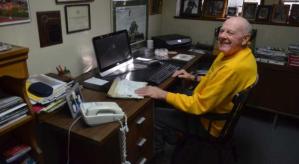
Those five Illinois basketball greats have all been inducted into the Illinois Basketball Coaches Association Hall of Fame, but now they’ll have to move over to welcome a new member to the group: longtime sports and current 22nd Century Media reporter, Loyola football beat writer, and Wilmette resident Neil Milbert.
Earlier this month, the association announced its 2018 hall of fame class, which includes Milbert, who will go in as one of seven media members during a May 5 banquet at Illinois State University in Normal. Milbert is being honored thanks to his many years at the Chicago Tribune and the last seven years of writing for 22nd Century Media.
“The body of work led me to getting the nomination to the hall of fame and it’s humbling because it’s a big honor. It was unexpected,” Milbert said. “I got a lifetime achievement award from the National Turf Writers Association a few years ago, but this one means more because there’s more basketball writers in Illinois than there are racing writers in the entire country.”
The sport of basketball has been a favorite of Milbert’s going back to a young age. As a child, Milbert was diagnosed with the rheumatic flu one summer, causing him to spend an entire summer in bed and really knocking him out from any sporting activities for two to three years.
That, in a way, turned out to be a blessing in disguise.
“I became a student of sports as a child because, when I was in bed that summer, I knew every player in baseball,” he said.
After graduating from Marquette University in 1961, a paper in Ottumwa, Iowa, hired the Iowa native to work on its news side, but he was only there for a couple months due to being drafted and enlisting in the Marine Corps. After six months of active duty and then serving four-and-a-half years in the reserves, Milbert joined his college roommate in New Jersey and worked the sports desk at The Jersey Journal in Jersey City, New Jersey, beginning in September of 1962.
Milbert worked his way up to the St. Peter’s College beat in 1965. He held the beat for three years, and witnessed some incredible moments, including a couple big upsets.
“I got these guys when they were sophomores,” Milbert said. “When they were juniors, the [National Invitation Tournament] was a big tournament because the NCAA field was much smaller. They got invited to the NIT and got blown out by Southern Illinois. So low and behold, the next year they managed to get back to the NIT and their first game, they win against Marshall. Second game, they play Duke, which was No. 4 in the country, and I thought, ‘St. Peter’s is going to get blown out again,’ because Duke had been upset in the ACC Tournament and therefore didn’t qualify for the NCAA Tournament. Low and behold, St. Peter’s upset Duke.
“Those were my first experiences covering college basketball.”
After coming to the Chicago Tribune in the early ’70s, Milbert had few opportunities to cover basketball. He mainly followed high school state playoff games when the paper would have its staffers cover regional and sectional games. At the time, Milbert was a Blackhawks beat writer, as well as the paper’s main horse racing reporter.
That was until the mid-’80s, when he was assigned the Northwestern men’s basketball beat.
“One [team I’ll remember] was a really good Northwestern team that had a bunch of guys transfer out. This new group came in as freshmen and Ricky Byrdsong came in [for] his first year as head coach,” Milbert said. “They went undefeated in nonconference play but struggled in conference play. To make it to the NIT, they needed to go .500 and had one game left, against Michigan, who had four of the Fab Five remaining. It was a terrible matchup, but Northwestern took them to overtime, upset them and went to the NIT.
“That was monumental and was a thrill for me to see how far these guys had come.”
Milbert would follow that up with covering the University of Illinois at Urbana-Champaign team that would make the NCAA title game, as well as sitting right in front of Bryce Drew when he hit an iconic 3-pointer to beat Ole Miss in the first round of the 1998 NCAA Tournament.
“I was sitting there, thinking, ‘Oh boy, not enough time, three seconds,’” Milbert added. “I see this guy wind up, throw the long pass the entire court, one of the Valpo players set it up to Bryce Drew and he hit the shot right in front of me. It was an incredible moment, I’ve never seen anything like that.”
Milbert left covering college basketball after leaving the Tribune and started writing for 22nd Century Media’s North Shore papers in 2010. One of his first assignments was a summer league basketball game between Glenbrook South and Loyola Academy.
He has a few high school basketball games he’ll always remember covering.
“A memorable team is Steve Weissenstein’s GBS girls team when they played in a tournament in Schaumburg,” Milbert said. “They struggled there, but Steve said, ‘Oh, we’re going to be good at the end of the year. These are all inexperienced girls and I like some of the things I saw. I wouldn’t want to play us in February.’
“And he was right. They turned it around and really had a good year. That to me was a mark of a good coach.”
Milbert noted that one of the major differences between covering high schools and colleges is that high school reporters have to do many things themselves. When covering college teams, reporters get stats handed to them and can request players and coaches to talk to through the media relations employees at the schools.
High schools are a different story.
“I’ve always had a respect for high school writers because in the old days, they always had to find a phone, to plug their computers in, and it’s always been more difficult because of that aspect,” he said. “As far as the game, the no shot clock. If a team gets the lead in the fourth quarter, they’ll sit on the lead. It’s a different game than college.
“I’ve only done a handful of professional games, but I like the high school game better. I like the coaches strategizing, things like that. I feel like there’s more coaching on the high school level, maybe not more than college but more than in the pros. Coaches can have a greater impact.”
The hall of fame banquet will be May 5 at Illinois State’s Redbird Arena and will include 99 new inductees.
 Michael Wojtychiw